
In 2026, AI Cyberattacks on Small Business startup companies are no longer thought to be “too small to hack.” Instead, they are the main targets of automated, AI-driven cyberattacks. This guide gives you a complete framework, from basic hygiene to advanced AI protection, to help you build a strong organization in a world that is very connected.
The digital world for small enterprises in the UK, USA, Canada, Japan, and other country is changing quickly as 2026 goes on. Business owners are right to wonder, “What are the best cybersecurity tips to keep my company safe this year?” because AI-driven assaults and ransomware are getting more advanced all the time.
Technology opens us amazing possibilities for growth and efficiency, but it also comes with big threats. The truth is that small firms are no longer “too small to hack.” In reality, they are often great targets because they have significant data but don’t have the same level of security as bigger companies.
This guide cuts through the technical language to give you a straightforward, useful plan. Here are some ways to keep your data safe, safeguard your reputation, and make sure your business does well in a world that is always connected.
Part 1: The 2026 Threat Landscape (Beginner)
If you’re just starting out in security, the most important thing to know is that automation has changed the game. Attackers are currently using AI to look for a single flaw across thousands of small networks at the same time.
Why Cybersecurity Is Critical for Businesses of All Sizes
Here are the three biggest threats to be aware of:
- Hyper-realistic phishing: It is when AI can make perfect, error-free emails and even copy the voices of your CEO or vendors to approve fake wire transfers.
- Double-Extortion Ransomware: Hackers don’t just lock your files anymore; they also steal your sensitive information and threaten to make it public if you don’t pay.
- Supply Chain Infiltration: Attackers might go after your smaller vendors to get a “backdoor” into your network.
Part 2: Important Security Checklist (Intermediate)
Once you know what the risks are, use these basic “Quick Wins” to stop up to 99% of automated attacks.
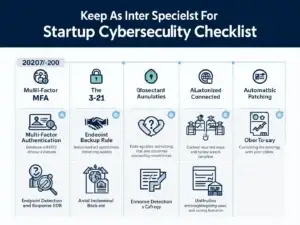
- Multi-Factor Authentication (MFA): All corporate accounts must have this. Put hardware keys (like YubiKeys) or authenticator apps that are “phishing-resistant” ahead of SMS codes.
- The 3-2-1-1-0 Backup Rule: The 3-2-1-1-0 Backup Rule says to keep three copies of your data on two different types of media, one copy offsite, one copy offline (which can’t be changed), and to test it regularly to make sure there are no errors.
- Endpoint Detection and Response (EDR): In 2026, regular antivirus software won’t be enough. To stop unexpected threats, use EDR technologies that watch activity in real time.
- Automatic Patching: Turn on automatic updates for all operating systems (Windows and macOS) and important third-party software like PDF readers and browsers.
In 2026, automated AI attacks specifically target startups. Here’s what you need to know:
- 🔐 Enable phishing-resistant MFA on all corporate accounts
- 💾 Follow the 3-2-1-1-0 backup rule with offline, immutable copies
- 🛡️ Replace antivirus with EDR for real-time threat detection
- 🏛️ Adopt Zero Trust with micro-segmentation and least privilege
- 📅 Implement the 90-day plan starting with password managers and MFA
⬇️ Full guide with implementation checklist and 90-day roadmap below ⬇️
Part 3: Advanced Resilience & Strategy (Advanced):
For mature enterprises, security in 2026 is all about governance and Zero Trust infrastructures.
How does cybersecurity actually work?
“Never Trust, Always Verify” is the motto of Zero Trust.
A Zero Trust model doesn’t trust anyone on your office network. Instead, it checks every request from every user and device, no matter where they are.
- Micro-segmentation: Keep key areas like finance or HR separate so that a single breach can’t affect the whole firm.
- Least Privilege Principle: Make sure that employees can only see the information they need to do their jobs.
Compliance & Insurance in 2026
Cyber insurance providers now act as de facto regulators. To qualify for coverage or avoid massive premiums, most businesses must demonstrate:
- Enforced MFA on all admin accounts.
- A documented and regularly tested incident response plan.
- Active monitoring of “Shadow AI” (unauthorized use of AI tools by employees).
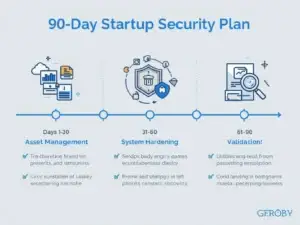
Part 4: A 90-Day Plan for Implementation
| Period | Timeline | Focus | Key Action |
| Days 1–30 | Set up a Password Manager | Enable MFA | Start an asset inventory |
| Days 31–60 | Hardening | Set up EDR, | Automate patching, start phishing simulations every month. |
| Days 61–90 | Validation | Check Incident Response Plan | Do a “Tabletop Exercise”, check vendor access |
Final Thought
Cybersecurity for Small Businesses is no more a project for information technology; rather, it is an insurance policy for the survival of a business. It is not businesses with the largest investments that will be the most resilient in the year 2026; rather, it is the companies that continuously provide the fundamentals and cultivate a culture that prioritizes security.
A comprehensive collection of 2026 cybersecurity plans, vital checklists, and advanced resilience measures for small enterprises are provided in these resources
Cybersecurity Tips for Small Business
Beginner’s Guide to Cybersecurity 2026: Safeguarding Your Digital World
3 thoughts on “AI Cyberattacks on Small Business: The 2026 Survival Guide”