
Understanding the primary types of cybersecurity attacks is essential for protecting modern systems against evolving digital threats. Cyberattacks target weak spots in computer networks, software, and human behavior to steal sensitive data, extort money, or disrupt operations. Major threat categories include AI-driven social engineering, ransomware, supply chain compromises, and credential theft.
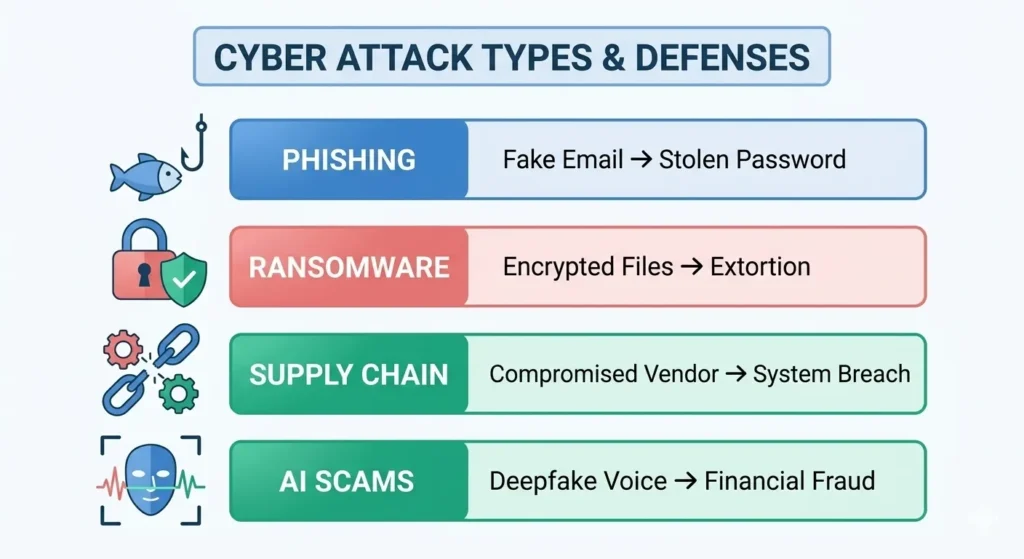
Cyberattacks represent not an unique threat but rather an evolving arsenal that attackers modify according to their objectives, targets, and technological resources. By 2026, the toolkit progressively includes AI-enhanced phishing, deepfake-driven deception, and supply chain vulnerabilities in addition to the traditional threats that security teams have been dealing with for many years.
Also Read:
Recognizing the many classifications of attacks is essential not just for security experts but also for all internet users. This manual explores the principal categories of cybersecurity assaults, their mechanisms, and strategies for counteraction.
Common Types of Cyber Attacks
- Phishing & AI Scams: Fake emails, messages, or deepfake audio/video trick people into giving away passwords or money.
- Ransomware: Harmful software that locks or scrambles files, demanding money from the victim to unlock them.
- Credential Theft: Hackers use stolen, leaked, or guessed passwords to log into real user accounts.
- Supply Chain Attacks: Hackers break into trusted software vendors or app updates to infect customers automatically.
- Denial of Service (DoS): Overloading servers or websites with heavy traffic to crash them or block real users.
- Insider Threats: Current or past employees or partners who misuse their access to leak or harm data.
How to Protect Against Attacks
- Multi-Factor Authentication (MFA): Require extra proof of identity beyond just a password.
- Zero Trust: Never trust any user or device automatically, even inside the network.
- Regular Backups: Keep offline or separate copies of key files to recover from ransomware quickly.
- Software Updates: Fix system vulnerabilities immediately using official patches.
1. Phishing Attacks
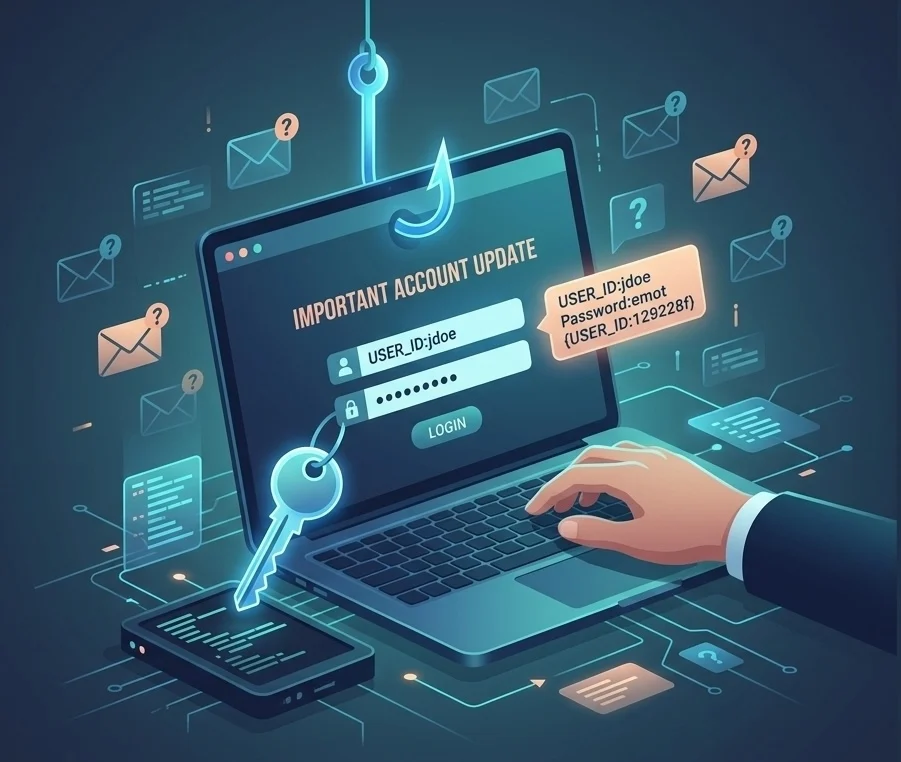
Phishing continues to be one of the most prevalent and efficient attack strategies as it focuses on individuals rather than solely on systems. Perpetrators dispatch false emails, texts, or communications that mimic legitimate entities — such as financial institutions, colleagues, or courier services — to deceive victims into clicking harmful links or divulging sensitive information.
Variants to know:
- Spear phishing — Highly targeted phishing aimed at a specific person, often using personal details to appear legitimate.
- Whaling — Phishing aimed at executives or high-profile targets.
- Smishing / Vishing — Phishing conducted via SMS text messages or voice calls.
Defense: Verify sender addresses, avoid clicking unexpected links, and enable multi-factor authentication so a stolen password alone isn’t enough to breach an account.
2. Malware
Malware, short for “malicious software,” refers to any application intended to damage, exploit, or obtain unauthorized entry into a system. Prevalent classifications encompass:
- Viruses — Attach themselves to legitimate files and spread when the file is executed.
- Worms — Self-replicating malware that spreads across networks without user action.
- Trojans — Malware disguised as legitimate software.
- Spyware — Secretly monitors user activity, often to steal credentials or financial data.
- Rootkits — Give attackers hidden, privileged access to a system while evading detection.
Defense: Keep systems patched, use reputable endpoint protection, and avoid downloading software from untrusted sources.
3. Ransomware
Ransomware enciphers a victim’s data or completely restricts access to their systems, subsequently requiring payment (often in cryptocurrency) for recovery. Contemporary ransomware factions frequently employ double extortion — pilfering data prior to encryption and subsequently threatening to disclose it publicly if the ransom remains unpaid.
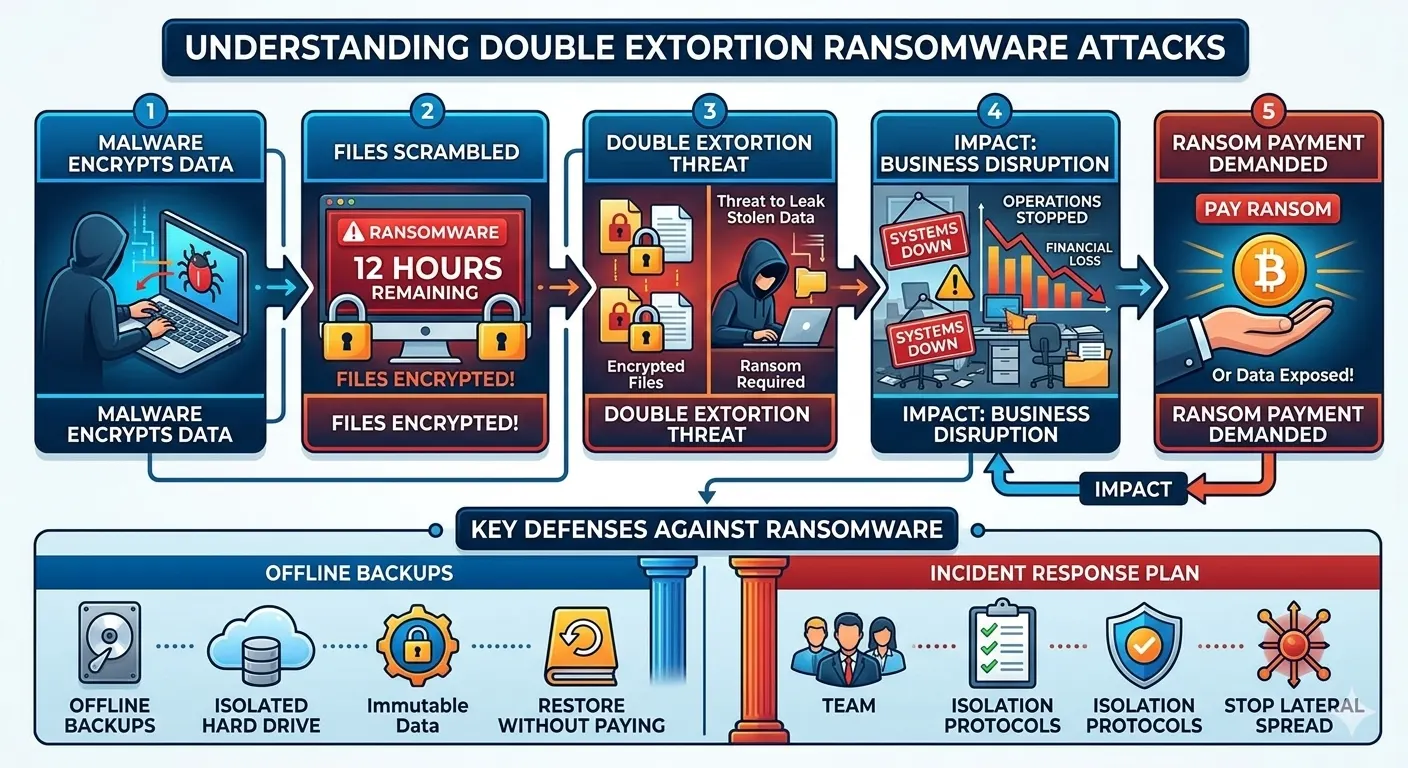
Ransomware-as-a-Service (RaaS) has diminished the entry threshold, enabling less proficient attackers to lease pre-packaged ransomware tools from illicit online platforms.
Defense: Preserve offline, verified backups; partition networks to prevent lateral ransomware propagation; and promptly address known vulnerabilities, as numerous ransomware incidents leverage unpatched software.
4. Denial-of-Service (DoS) and DDoS Attacks
A Denial-of-Service assault overflows a system, server, or network with excessive traffic, rendering it unable of addressing valid requests. A Distributed Denial-of-Service (DDoS) assault employs an extensive network of infected devices (a botnet), complicating mitigation efforts due to the traffic originating from myriad sources.
Defense: Employ traffic-filtering services, content delivery networks (CDNs), and rate-limiting to mitigate or manage surges of harmful traffic.
5. Man-in-the-Middle (MitM) Attacks
In a MitM attack, an assailant clandestinely intercepts and may modify the communication between two entities who are under the impression they are engaging directly with one another. This phenomenon is particularly prevalent on unprotected public Wi-Fi networks.
Prevalent methods include session hijacking, SSL stripping (degrading a secure HTTPS connection to unencrypted HTTP), and Wi-Fi eavesdropping.
Defense: Utilize encrypted connections (HTTPS, VPNs), refrain from conducting important transactions on public Wi-Fi, and heed browser alerts on invalid certificates.
6. SQL Injection
SQL injection takes advantage of improperly protected input areas (such as login or search forms) to embed harmful database instructions. A successful breach may enable an assailant to access, alter, or erase information — such as usernames, passwords, and financial records — directly from a website’s database.
Defense: Programmers ought to employ parameterized queries and do input validation; this is fundamentally a web application security concern rather than an issue that can be mitigated by individual users.
7. Cross-Site Scripting (XSS)
XSS assaults embed harmful scripts onto reliable websites, subsequently executing in the browsers of unwitting users. This may be employed to appropriate session cookies, divert users to harmful websites, or alter content.
Defense: Developers ought to cleanse user input and implement Content Security Policy (CSP) headers to restrict the execution of scripts on a webpage.
8. Social Engineering
Social engineering exploits psychological factors instead of technological weaknesses. Malefactors manipulate trust, haste, fear, or curiosity to convince victims to circumvent standard security protocols.
Instances include pretexting (fabricating a false narrative to obtain information), baiting (abandoning contaminated USB drives for individuals to connect), and tailgating (physically trailing an authorized individual into a secured zone).
Defense: The most efficacious countermeasure is security awareness training, as social engineering primarily exploits individuals rather than software.
9. Supply Chain Attacks
Instead of directly attacking a target, supply chain assaults target a reliable third-party vendor, software update, or open-source element upon which the target depends. Due to the fact that the harmful code is transmitted via a reliable conduit, it is frequently more challenging to identify.
Evaluate third-party providers meticulously, oversee software dependencies for recognized vulnerabilities, and implement the principle of least privilege to mitigate the potential harm from a compromised element.
10. AI-Powered and Deepfake Attacks (Emerging in 2026)
As generative AI tools have become more accessible, attackers increasingly use them to scale and sharpen their techniques:
- AI-generated phishing — Highly convincing, grammatically flawless phishing emails tailored to individual targets using scraped personal data.
- Deepfake voice and video fraud — Cloned voices or video used to impersonate executives or family members in real-time scams, including fraudulent wire transfer requests.
- Automated vulnerability discovery — AI tools used to scan for and exploit software weaknesses faster than manual methods allow.
Defense: Verify unusual requests (especially financial ones) through a separate communication channel, and treat unexpected urgency — even from a familiar “voice” — as a red flag worth double-checking.
How to Protect Yourself Against These Attacks
While each attack type has specific defenses, a few foundational habits reduce your risk across the board:
- Keep all software, browsers, and operating systems updated.
- Use strong, unique passwords with a password manager.
- Enable multi-factor authentication everywhere it’s available.
- Back up important data regularly and store at least one copy offline.
- Be skeptical of urgent, unexpected requests — even from familiar contacts.
- Invest in ongoing security awareness training if you manage a team.
Final Thoughts
Cyberattacks in 2026 blend old tactics with new technology — phishing hasn’t gone away, it’s just gotten smarter with AI. Understanding how each attack type works is the first step toward recognizing the warning signs before damage is done. No single tool can stop every threat, but a combination of good habits, layered defenses, and ongoing awareness goes a long way toward keeping you and your organization safe.
Safeguard your organization against common types of cybersecurity attacks by adopting a Zero Trust posture, enforcing Multi-Factor Authentication (MFA), and conducting routine security awareness training. Stay proactive to keep your systems resilient against emerging 2026 threats.